Most people who say they want to “make a crypto coin” actually want to make a token — a digital asset that runs on top of an existing blockchain like Ethereum or Solana, rather than a coin with its own independent blockchain. That distinction decides almost everything else: cost, timeline, technical complexity, and how much control you actually end up with — and, if you’re curious about when was bitcoin created, why that history still shapes coin and token design today. This guide walks through both paths and the steps involved in either one, independently and without trying to sell you a deployment service.

Coin vs. token: the fork in the road
A coin has its own blockchain — its own network of computers validating transactions, its own consensus rules, its own native currency. Bitcoin and Ethereum’s own currency (ETH) are coins in this sense. A token is issued on top of someone else’s blockchain, using that chain’s existing infrastructure and security. Most tokens people encounter — including the vast majority of new crypto projects — are built this way. For the full comparison, see coin vs. token: what’s the real difference.
Building your own blockchain from scratch means running validator or mining infrastructure, securing a novel network against attack, and convincing other people to actually run nodes on it. It is a significant, ongoing technical undertaking. Building a token means writing (or configuring) a smart contract on a blockchain that already has that infrastructure solved. For nearly everyone starting out, a token is the realistic starting point.
Step 1: decide why you’re doing this
Before any technical decision, the use case should be clear: is this a utility token for a specific application, a governance token for a community or protocol, a fundraising mechanism, or an experiment to learn how the technology works? The use case shapes the tokenomics decisions in step 3 and determines whether a token is even the right tool — plenty of projects don’t need a token at all.
Step 2: choose your approach
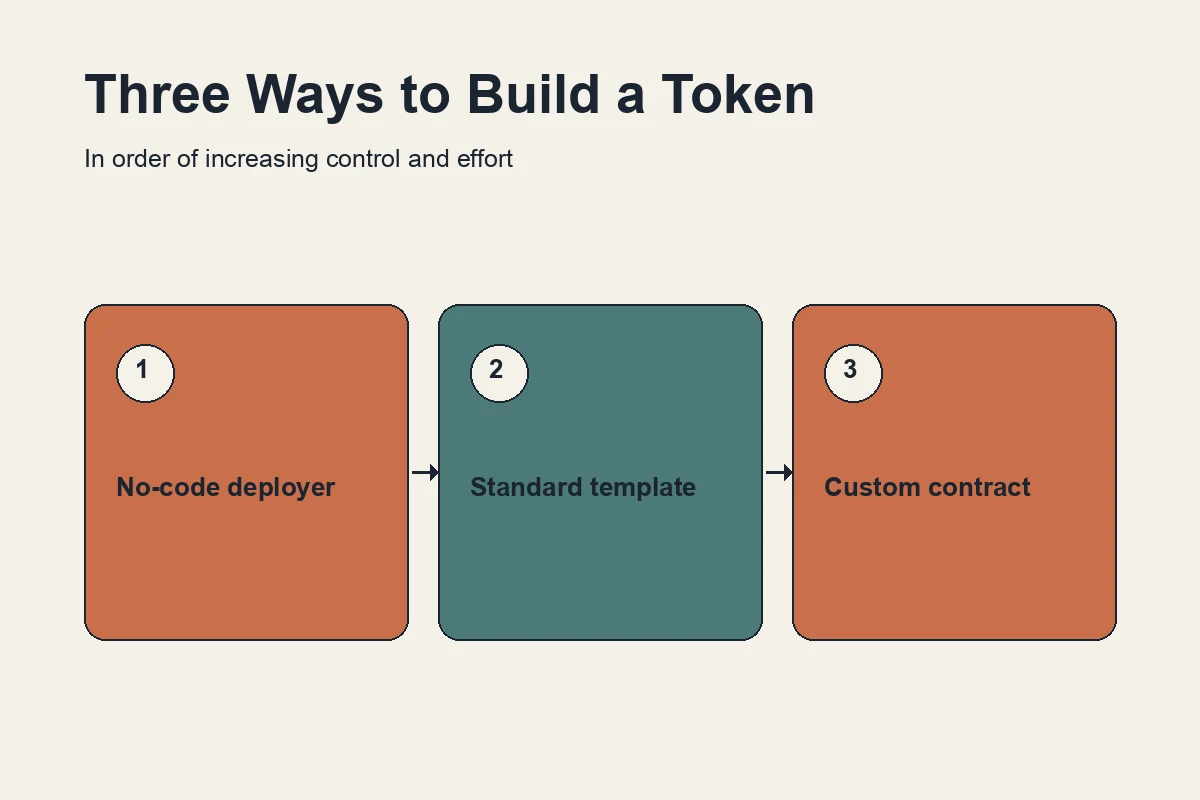
Assuming a token is the right fit, there are three broad routes, in increasing order of control and technical effort:
- No-code deployers — web tools that let you configure a basic token (name, supply, symbol) and deploy it without writing code. Fast, but limited to whatever the tool supports, and the underlying contract code is someone else’s.
- Standard token templates — using a well-audited, widely used standard such as ERC-20 on Ethereum, BEP-20 on BNB Chain, or SPL on Solana. This is the most common professional approach: proven code, broad wallet and exchange compatibility, and room to customize.
- Custom smart contracts — writing bespoke contract logic for non-standard behavior (vesting schedules, transaction fees, mint/burn rules). More flexible, but every custom line of code is also a new place for a bug or exploit to hide.
The official ERC-20 documentation is a good primary reference for what a standard token contract actually specifies, regardless of which chain you eventually choose.
Step 3: design the tokenomics before writing any code
Tokenomics — total supply, distribution, how (or whether) new tokens are issued over time, and what the token is actually used for — should be settled before development starts, not adjusted afterward. Changing supply mechanics after launch is difficult, often impossible without breaking trust with early holders, and sometimes technically impossible depending on how the contract was written.
Step 4: build, test, and get an independent security review
Whether using a template or custom code, the contract needs to be tested thoroughly on a public testnet before any real funds touch it, and — for anything beyond a personal experiment — reviewed by an independent security auditor. Smart contract code is immutable once deployed in most cases; a bug found after launch is far more expensive than one found before it.
Step 5: launch and maintain
Launching means deploying the contract to the mainnet, then handling the parts that aren’t code: getting listed on wallets and, eventually, exchanges; communicating clearly with holders; and maintaining whatever infrastructure the project depends on. A token doesn’t stop requiring attention once it’s deployed.
Common mistakes worth avoiding
A few patterns show up repeatedly in projects that struggle after launch:
- Treating tokenomics as an afterthought. Supply, distribution, and unlock schedules get decided in an afternoon, then the team spends months building on top of a foundation nobody stress-tested.
- Copying contract code without understanding it. Deploying code nobody on the team can explain line by line means nobody can catch a subtle bug — or a subtly malicious modification — before it costs someone money.
- Skipping the testnet stage under time pressure. Rushing straight to mainnet to hit a launch date trades a cheap mistake now for an expensive one later.
- Budgeting zero time or money for a security review. Skipping one entirely on anything holding real value is a common reason small, avoidable bugs turn into large, public losses.
- Building a token before confirming anyone needs it. The tokenomics and the audit only matter if there’s a real use case underneath them — see step 1.
Why this site exists
Most content about “making a crypto coin” is published by a platform that’s also selling you the deployment service — which makes it hard to tell an honest technical explanation from a sales pitch. Mayosol doesn’t sell anything. Nothing here is investment advice.
Key terms, explained
Crypto discussion leans on a lot of specific vocabulary. Here’s what the terms used throughout this page actually mean, in plain language.
- Blockchain — A record of transactions copied across many independent computers instead of one central server, with new entries added in blocks that are cryptographically linked to the block before them. See what is a blockchain for the full explanation.
- Coin — A cryptocurrency with its own independent blockchain — its own validators, its own consensus rules, its own native currency. Bitcoin and Ethereum’s ETH are both coins.
- Token — A cryptocurrency issued on top of someone else’s blockchain via a smart contract, inheriting that chain’s security instead of running its own. Most new crypto projects are tokens, not coins.
- Smart contract — Code stored on a blockchain that runs automatically when called, following rules nobody can quietly change after deployment. Tokens are implemented as smart contracts.
- Consensus mechanism — The method a blockchain’s independent nodes use to agree on which version of the shared ledger is correct, without a central authority making the call.
- Wallet — Software or hardware that manages the cryptographic keys controlling access to funds on a blockchain — it doesn’t literally “store” coins, it stores the keys that prove ownership.
- Private key — A secret piece of data that proves ownership of a wallet’s funds and authorizes spending them. Anyone with the private key controls the funds, regardless of who “owns” the wallet.
- Seed phrase — A human-readable sequence of words (commonly 12 or 24) that can regenerate a wallet’s private keys. Losing it without a backup usually means losing access permanently.
- Gas fee — The payment required to have a transaction or smart contract call processed on networks like Ethereum, compensating the validators who do the computational work.
- Testnet — A copy of a blockchain’s network used for testing, where the native currency has no real value, letting developers find mistakes before deploying to mainnet.
- Tokenomics — The rules governing a token’s supply, distribution, and incentives — how many exist, who holds them, and how (or whether) that changes over time.
- Vesting — A schedule that releases allocated tokens gradually over time rather than all at once, typically used for team and early-investor allocations.
- Stablecoin — A token designed to track the value of another asset, usually a fiat currency like the US dollar, using collateral or algorithmic mechanisms to hold that peg.
- Whitepaper — A document describing a project’s technical design and goals before or at launch. Bitcoin’s whitepaper, published in October 2008, is the namesake example.
- Audit (smart contract) — An independent security review of a smart contract’s code, intended to catch bugs and vulnerabilities before (or after) deployment.
- Rug pull — A scenario where a token’s creators abandon a project and withdraw its liquidity or funds, leaving holders with a worthless asset — a risk audits and transparent tokenomics are meant to reduce.
- Verified contract — A smart contract whose publicly readable source code has been confirmed to match its deployed bytecode, letting anyone independently check what the contract actually does.
- Mint (token action) — The act of creating new units of a token, which may happen once at deployment, on an ongoing schedule, or never again, depending on how the contract was written.
- Peg — The target value a stablecoin is designed to track, usually a fiat currency — “maintaining the peg” means keeping the token’s market price close to that target.
- Node operator — A person or organization running a node — a computer holding a full copy of a blockchain’s ledger and participating in validating transactions.
- Deflationary token — A token whose supply mechanism reduces the total amount over time, commonly through burning, as distinct from a fixed-supply or inflationary (ongoing-issuance) design.
Frequently asked questions
Questions that come up repeatedly once someone starts actually looking into creating a coin or token — answered directly, without steering toward a specific platform or service.
Do I need to know how to code to create a token?
Not necessarily. No-code deployers can configure a basic token without writing anything, and standard templates like ERC-20 exist specifically so you don’t have to write a contract from scratch. Custom behavior — non-standard fees, vesting logic, minting rules — does require someone who can write and test smart contract code, or hiring someone who can.
What’s the difference between a cryptocurrency and a token?
“Cryptocurrency” is the umbrella term for both. A coin has its own blockchain; a token is issued on an existing blockchain via a smart contract. See coin vs. token: what’s the real difference for the full comparison.
Is it legal to create your own cryptocurrency?
In most jurisdictions, creating a token is not itself illegal, but how it’s marketed, sold, and used can trigger securities, tax, or consumer-protection law depending on where you and your users are located. Rules vary significantly by country and change over time — this isn’t legal advice, and anyone planning a real launch should check current regulations with a qualified professional in the relevant jurisdictions.
How long does it take to launch a token?
A basic no-code token can be deployed in well under an hour. A project with custom contract logic, a completed tokenomics design, testnet validation, and an independent audit typically takes weeks to months — audits alone commonly take one to several weeks depending on contract complexity and auditor availability.
What blockchain should I choose for my token?
It depends on your users, budget, and required features — this site doesn’t rank specific chains, since the right answer changes with each project’s needs and with how each network evolves over time. Established chains with mature tooling and standard token formats (like ERC-20 on Ethereum) are generally the lowest-risk starting point for a first project.
Can a token have unlimited supply?
Yes — some tokens are designed with no fixed maximum supply and mint new units over time, similar to how some fiat currencies work. Others cap the total supply permanently at deployment. Neither approach is inherently better; it depends on the token’s intended use, and it’s a decision that belongs in the tokenomics design step, not an afterthought.
Can I change my token’s total supply after launch?
Only if the contract was specifically written to allow it. Many token contracts are deliberately written without that capability, precisely so holders can trust the supply won’t be changed later. Retrofitting that capability into an already-deployed, immutable contract generally isn’t possible — it has to be decided before deployment.
Do I need a smart contract audit for a small project?
If real funds — yours or anyone else’s — will touch the contract, an audit is one of the highest-value steps available, regardless of project size. Skipping it on a “small” project is a common way small mistakes turn into total losses, precisely because small projects are also the ones least likely to have caught a bug through informal review.
Is Bitcoin a coin or a token?
Bitcoin is a coin — it has its own independent blockchain, its own validators (miners, in Bitcoin’s case), and its own consensus rules. See when was Bitcoin created for the full history.
Why can’t I just copy Bitcoin’s code to make my own coin?
Technically, Bitcoin’s code is open source and can be copied. The hard part isn’t the code — it’s convincing enough independent people to run nodes and secure the new network. A copy of Bitcoin’s code with almost no validators is far easier to attack than Bitcoin itself, which is exactly why creating a genuinely new, secure coin is much harder than deploying a token.
What is gas, and why do transactions cost money?
Gas is the fee paid to have a transaction or smart contract call processed on networks like Ethereum, compensating the validators whose computing resources actually do the work. It exists partly to fund network security and partly to prevent spam — without a cost, nothing would stop the network from being flooded with junk transactions.
What’s the difference between a hot wallet and a cold wallet?
A hot wallet stays connected to the internet, which is convenient for frequent use but leaves it more exposed to remote attacks. A cold wallet keeps its private keys offline — a hardware device or even a paper backup — trading convenience for reduced exposure. Funds meant to be held long-term are commonly kept cold; funds needed for regular transactions are commonly kept hot.
Can a token’s smart contract be hacked?
The contract itself can’t be “hacked” in the sense of breaking into a server, since it simply executes whatever logic was written into it — but a contract with a bug or an unintended vulnerability can be exploited by anyone who finds it, which is exactly what an audit is meant to catch before deployment.
What’s the difference between a public and private blockchain?
A public blockchain lets anyone run a node, submit transactions, and read the full history. A private (permissioned) blockchain restricts that access to a known set of participants, trading away the “no central authority” property for more control — see what is a blockchain for the fuller explanation.
Major blockchain networks, compared
Choosing a host blockchain for a token means choosing among networks with real, documented differences in how they’re secured and what standards they use. Here’s where the most commonly used ones stand, using only their own well-documented, stable characteristics rather than volatile figures like current fees or prices.
| Network | Native coin | Consensus | Launched |
|---|---|---|---|
| Bitcoin | BTC | Proof of work | 2009 |
| Ethereum | ETH | Proof of stake (since 2022; proof of work before that) | 2015 |
| BNB Chain | BNB | Proof-of-stake-based consensus | 2019 (BNB itself launched as an ERC-20 token in 2017 before migrating) |
| Solana | SOL | Proof of stake, combined with a timestamping mechanism for fast transaction ordering | 2020 |
| Cardano | ADA | Proof of stake (Ouroboros) | 2017 |
Bitcoin. The original blockchain network, primarily used as a store of value and payment network. Bitcoin’s scripting language is deliberately limited compared to later networks, so it isn’t the usual choice for deploying general-purpose tokens — see when was Bitcoin created for its history.
Ethereum. The network where the ERC-20 token standard originated, and still the most common home for general-purpose smart contracts. Its shift from proof of work to proof of stake in 2022 was one of the largest coordinated protocol changes any major blockchain has undergone.
BNB Chain. Associated with the Binance exchange. Uses the BEP-20 token standard, which is deliberately similar to ERC-20 to make porting existing token contracts straightforward.
Solana. Known for high transaction throughput and low fees relative to Ethereum. Uses the SPL token standard rather than ERC-20 or BEP-20, since it’s architecturally a different kind of network.
Cardano. Built with a research-first development process, with protocol changes typically going through academic peer review before implementation — a slower but more conservative approach than some other networks.
More guides
This page covers the core question end to end. For deeper dives into specific pieces: coin vs. token, in more depth, what a blockchain actually is, and the history behind Bitcoin — or see the guides hub for all of them in one place.