Remote payroll is not just a choice between a bank transfer and a blockchain transaction. A team needs a reliable way to approve amounts, reach each person, handle exceptions, and reconcile what was actually paid. When comparing payroll outsourcing with an in-house process, start by mapping the full monthly workflow—not by assuming that one payment rail is automatically faster, cheaper, or suitable everywhere.
First decide what the payroll process must do
Before evaluating providers or assets, write down the actual operating requirements. How many people are paid, how often, in which currencies, and to which kinds of accounts or wallets? Who confirms that work is complete? Who can approve a change to an amount or destination? What records must finance retain? Answers will vary by team, but documenting them makes a bank-based, crypto-enabled, or mixed process comparable.
Separate the recipient experience from the sender’s convenience. A method that is easy for a treasury team may create conversion steps, fees, custody work, or tax-record complexity for the person receiving funds. Ask recipients which lawful and practical options they can use, and do not collect wallet addresses or identity documents through informal public channels.
Fiat, stablecoins, or a mixed model?
There is no universally best route. A conventional bank payment may fit recipients who want local currency deposited into an account and a familiar statement trail. A stablecoin transfer may be considered where the recipient can safely receive, hold, and convert that asset and where the arrangement is appropriate for the parties and jurisdictions involved. A mixed approach can support different recipient preferences, but it creates more procedures to maintain.
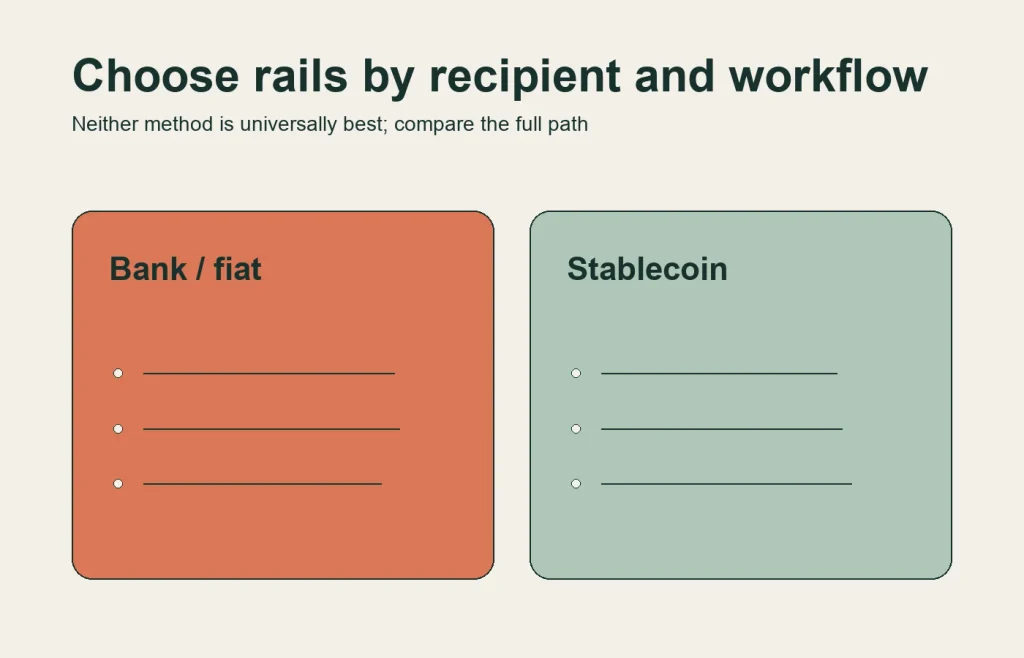
Evaluate each route across the whole journey: funding, transfer, receipt, conversion if needed, and accounting. A low quoted transfer fee does not by itself establish a lower total cost. Include intermediary or platform fees, network charges, foreign-exchange spreads, failed-transfer handling, reconciliation effort, and the time someone spends resolving exceptions.
Stablecoins are designed to track a reference value, but that design goal does not remove issuer, reserve, redemption, custody, liquidity, network, or operational risks. The Bank for International Settlements discusses potential benefits, challenges, and jurisdictional differences in its CPMI report on stablecoins in cross-border payments. Teams should treat a token balance as a distinct payment asset, not as identical to cash in a bank account.
A practical monthly payout workflow
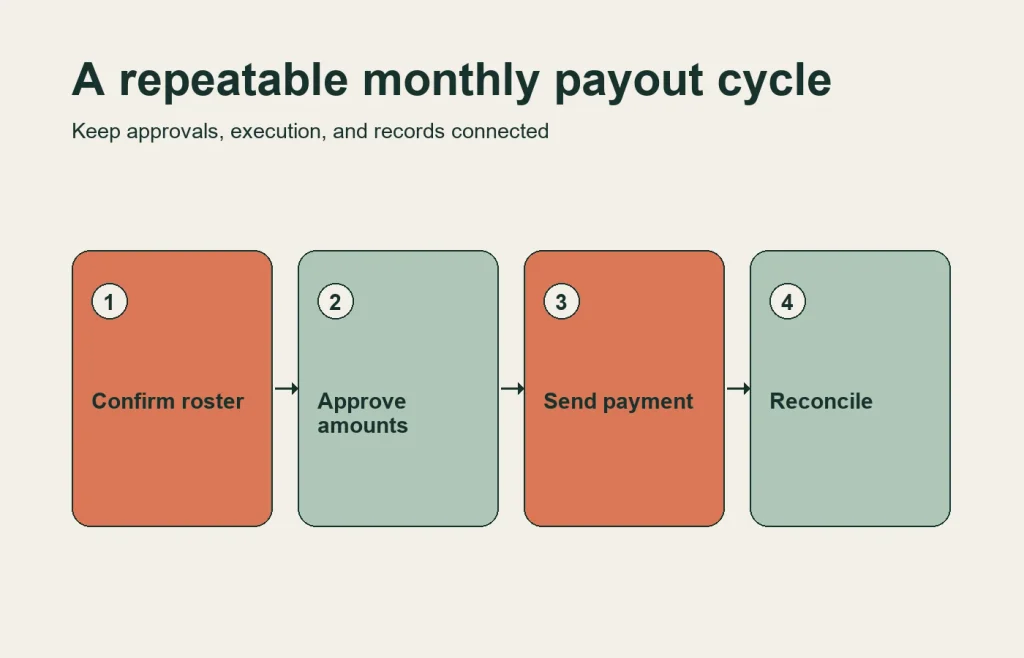
- Freeze the roster and terms. Confirm who is due to be paid, the approved amount, currency or asset, expected date, and the relevant agreement or invoice. Record changes instead of relying on chat history.
- Review and approve. Have an authorized person check the list against completed work and the approved budget. Where practical, separate preparation from approval so one account or person is not responsible for every control.
- Validate the destination. Confirm bank or wallet details using a secure, established process. For a wallet, verify the network as well as the address. Treat a last-minute change as a verification event, not a routine edit.
- Send and record. Capture the date, amount, asset, destination reference, fees, conversion basis where relevant, approver, and payment status. Keep sensitive documents access-limited.
- Reconcile and resolve exceptions. Match each approved item to a completed transfer or bank record. Assign an owner and next action to delayed, returned, underpaid, or disputed items.
Build a payout calendar with clear cutoffs
A calendar should show more than the day money is sent. Include a cutoff for submitted invoices or timesheets, a review window, approval deadline, payment date, and reconciliation deadline. Make the owner and backup owner visible. For people in different time zones, communicate the date and time zone explicitly; “Friday” can mean different things to different participants.
Keep a short exception path for missing documentation, incorrect destinations, insufficient balances, network congestion, or a recipient who cannot use the selected method. Define who pauses a payment, who contacts the recipient, and what evidence is needed before resending. Avoid sending a second transfer simply because the first one appears delayed until its status has been checked.
For example, a team that pays once a month might close submissions several business days before payday, review the batch on a fixed day, and reserve the following day for corrections. The exact spacing should fit the team’s agreements and banking or provider cutoffs. The useful principle is to leave a visible gap between submission, approval, and release so that errors can be caught before funds move.
A lightweight monthly checklist
- Before cutoff: remind contributors which records are due and how to report a changed payment destination.
- At review: compare the roster with approved work, agreed amounts, currency or asset, and due dates.
- Before release: verify destination details, available funding, approval authority, and any conversion or network assumptions.
- After release: match payment references to recipients, record fees and status, and assign unresolved exceptions.
- At month end: review recurring problems and update the next cycle’s cutoff, owner, or instructions where needed.
This checklist is an operating aid, not a universal compliance standard. Teams should adapt the controls to their size, risk profile, service providers, agreements, and professional advice.
What to compare when evaluating a provider
Ask providers to explain the operational details in writing. The useful comparison is not a slogan such as “instant global payments,” but a documented description of supported countries and currencies, onboarding and verification requirements, payout timing, fee structure, conversion rates, customer support, transaction records, access controls, and how errors are handled. Confirm which entity provides each part of the service and what happens if an account, transfer, or conversion is restricted.
For a crypto-enabled process, also ask which assets and networks are supported, how wallet ownership and destination changes are verified, what the custody model is, how reversals or mistaken transfers are handled, and what records can be exported. On-chain transfers can be difficult or impossible to reverse once confirmed, so the control before release matters. The FATF’s risk-based guidance for virtual assets describes the importance of applying controls appropriate to the activity; it is not a substitute for advice on the rules that apply to a particular team.
Keep records useful, not excessive
A monthly record can link the approved roster, supporting invoice or milestone evidence, approval, transfer confirmation, fee, any conversion calculation, and reconciliation result. Limit access to information that identifies people or exposes financial details. Establish a retention and deletion approach with qualified advisers for the relevant jurisdictions rather than keeping every document indefinitely by default.
At month end, review the exceptions as well as the successful payments. Were any approvals late? Did a recipient face an unexpected conversion step? Did a payment require manual repair? Did the team use an undocumented exchange rate or fee estimate? A short review turns those observations into a change for the next cycle.
Questions to answer before choosing
- Can each recipient receive and use the proposed method in their location?
- What is the all-in cost from funding through recipient access—not only the visible transfer fee?
- Which person prepares, approves, sends, and reconciles each payment?
- How are changed bank details or wallet addresses verified?
- What records can the team export, and who is allowed to access them?
- What is the documented response to a failed, delayed, returned, or misdirected payment?
Frequently asked questions
Should a remote team pay everyone in stablecoins?
Not by default. Recipient access, preference, conversion options, fees, operational controls, and the relevant jurisdiction all matter. A team should compare the complete process and avoid treating a stablecoin as risk-free cash.
Is a mixed fiat and stablecoin payroll easier?
It can accommodate different recipient needs, but it also means maintaining more than one approval, funding, support, and reconciliation path. Use a mixed model only when the benefit justifies that added operational work.
What should be checked before a crypto payout?
Confirm the approved amount and asset, recipient destination and network, fees, payment authorization, and a secure procedure for address changes. Record the transaction reference and check its status before treating the payment as complete.
Does a payment provider determine whether a contractor is legally classified correctly?
No. A payment method or provider does not, by itself, resolve employment classification, tax treatment, sanctions, or other legal questions. These depend on the facts and jurisdictions involved and should be reviewed with qualified professionals.
This article is general educational information, not legal, tax, employment, or investment advice. Payment methods and requirements differ by jurisdiction and may change; obtain professional advice for the team’s specific circumstances.