A coin has its own independent blockchain. A token is issued on top of someone else’s blockchain and depends on that chain’s validators and security. That’s the entire distinction — but it has large practical consequences for cost, control, and how fast something can actually launch.
What makes something a coin
Bitcoin is a coin: it has its own blockchain, its own network of nodes validating transactions, and its own consensus rules. Ethereum’s native currency, ETH, is also a coin for the same reason — it’s the base asset of the Ethereum blockchain itself, not something built on top of it. Creating a new coin means creating a new blockchain: writing or forking consensus software, and — critically — getting enough independent participants to actually run nodes and secure the network. A blockchain with few participants is easier to attack or manipulate, which is a real security problem, not just a cosmetic one.
What makes something a token
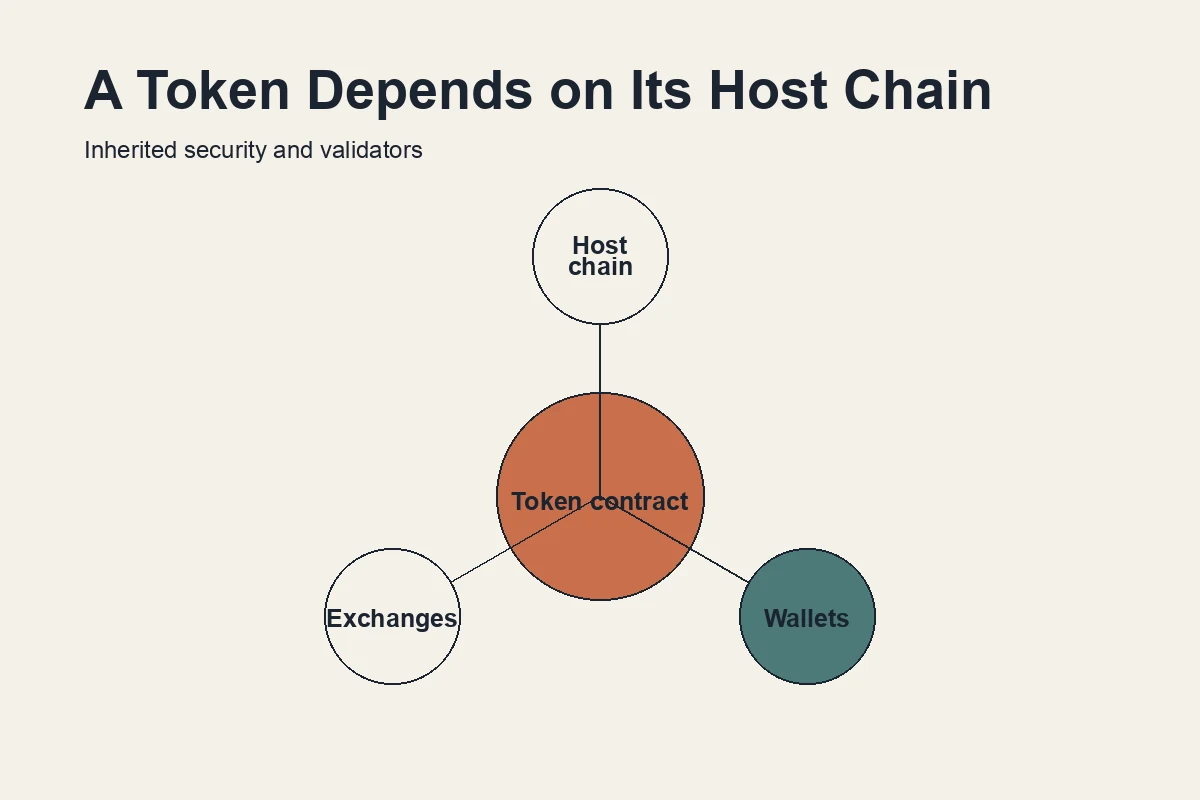
A token doesn’t have its own blockchain. It’s a smart contract deployed on an existing chain — an ERC-20 contract on Ethereum, a BEP-20 contract on BNB Chain, an SPL token on Solana — that keeps track of balances and handles transfers using rules the host blockchain already enforces. The token inherits the host chain’s security and validator network instead of needing its own. See what is a blockchain? for how that underlying validation actually works.
Side-by-side comparison
On infrastructure: a coin requires and maintains its own network; a token uses infrastructure that already exists. On security: a coin’s security depends on how many independent validators it can attract; a token inherits the security of a well-established host chain. On effort to launch: a coin can take months to years of protocol development; a basic token can be deployed using a standard, audited template in a fraction of that time. On control: a coin’s creators can, in principle, change consensus rules; a token is constrained by whatever the host blockchain allows a smart contract to do. On upgrades: changing a coin’s rules requires coordinating every node operator on the network to adopt the new software, which can split the network if enough of them disagree; changing a token’s contract logic depends entirely on whether the original contract was written to allow upgrades at all, and many deliberately aren’t, specifically so holders can trust the rules won’t move under them. Neither approach is strictly better — a coin’s flexibility to evolve is also a coordination burden, and a token’s rigidity is also a promise made in code rather than in a company’s terms of service.
Why most new projects choose tokens
Building a secure, independent blockchain from nothing is a substantial and ongoing technical commitment, and a new chain with few validators is genuinely more vulnerable than one that inherits security from an established network. That’s why the large majority of new crypto projects today are tokens rather than coins — see how to make a crypto coin for the practical steps involved in building one.
When building your own blockchain actually makes sense
A new coin — a genuinely new blockchain — makes more sense when the project needs consensus rules, transaction throughput, or governance that no existing chain can support, and when there’s a credible path to attracting enough independent validators to secure it. That’s a narrow set of cases. For almost everything else — a specific application, a community currency, a governance mechanism — a token on an established chain solves the same problem with far less infrastructure risk.
How wallets and exchanges treat the difference
The coin/token split isn’t just theoretical — it shows up in how software handles each one. A wallet that supports a blockchain natively (say, an Ethereum wallet) can usually display any standard token issued on that chain automatically, because the token is just data managed by a contract the wallet already knows how to read. A coin with its own blockchain needs explicit, separate support: wallet software has to be built or updated to understand that specific network’s rules from scratch. The same is true for exchanges — listing a new token on an existing chain is comparatively routine, while listing a new coin usually means integrating an entirely new blockchain into the exchange’s infrastructure, which is a heavier, slower process.
A concrete example of both, side by side
Ether (ETH) is a coin: it’s the native asset of the Ethereum blockchain, and Ethereum’s own validators secure it directly. The thousands of ERC-20 tokens that also live on Ethereum — including most stablecoins and governance tokens in circulation — are tokens: each one is a smart contract that relies entirely on Ethereum’s validators for security and settlement, without running any infrastructure of its own. If Ethereum’s network were compromised, every token built on it would be affected too, precisely because they don’t have independent security to fall back on. That shared fate is the tradeoff a token accepts in exchange for not having to build and secure a blockchain from zero.
Can a token become a coin later?
It happens, though rarely, and it’s a useful case study in how large the jump actually is. Binance’s BNB is a widely cited example: it launched as an ERC-20 token on Ethereum, then later moved to Binance’s own purpose-built blockchain as the project grew. That migration wasn’t a settings change — it meant standing up an entirely new network, recruiting validators to secure it independently, and coordinating every wallet and exchange that supported the asset to switch over to the new chain at once. Very few projects that start as tokens ever make that move, precisely because it requires solving the same independent-security problem that made starting as a token the easier option in the first place. It’s a useful reminder that “coin” and “token” aren’t permanent labels baked into an asset’s identity — they describe what infrastructure it currently depends on.
Next: the mechanism both coins and tokens rely on — what is a blockchain, and how does it actually work?