Most people who say they want to “make a crypto coin” actually want to make a token — a digital asset that runs on top of an existing blockchain like Ethereum or Solana, rather than a coin with its own independent blockchain. That distinction decides almost everything else: cost, timeline, technical complexity, and how much control you actually end up with. This guide walks through both paths and the steps involved in either one.
Coin vs. token: the fork in the road
A coin has its own blockchain — its own network of computers validating transactions, its own consensus rules, its own native currency. Bitcoin and Ethereum’s own currency (ETH) are coins in this sense. A token is issued on top of someone else’s blockchain, using that chain’s existing infrastructure and security. Most tokens people encounter — including the vast majority of new crypto projects — are built this way. For the full comparison, see coin vs. token: what’s the real difference.
Building your own blockchain from scratch means running validator or mining infrastructure, securing a novel network against attack, and convincing other people to actually run nodes on it. It is a significant, ongoing technical undertaking. Building a token means writing (or configuring) a smart contract on a blockchain that already has that infrastructure solved. For nearly everyone starting out, a token is the realistic starting point.
Step 1: decide why you’re doing this
Before any technical decision, the use case should be clear: is this a utility token for a specific application, a governance token for a community or protocol, a fundraising mechanism, or an experiment to learn how the technology works? The use case shapes the tokenomics decisions in step 3 and determines whether a token is even the right tool — plenty of projects don’t need a token at all.
Step 2: choose your approach
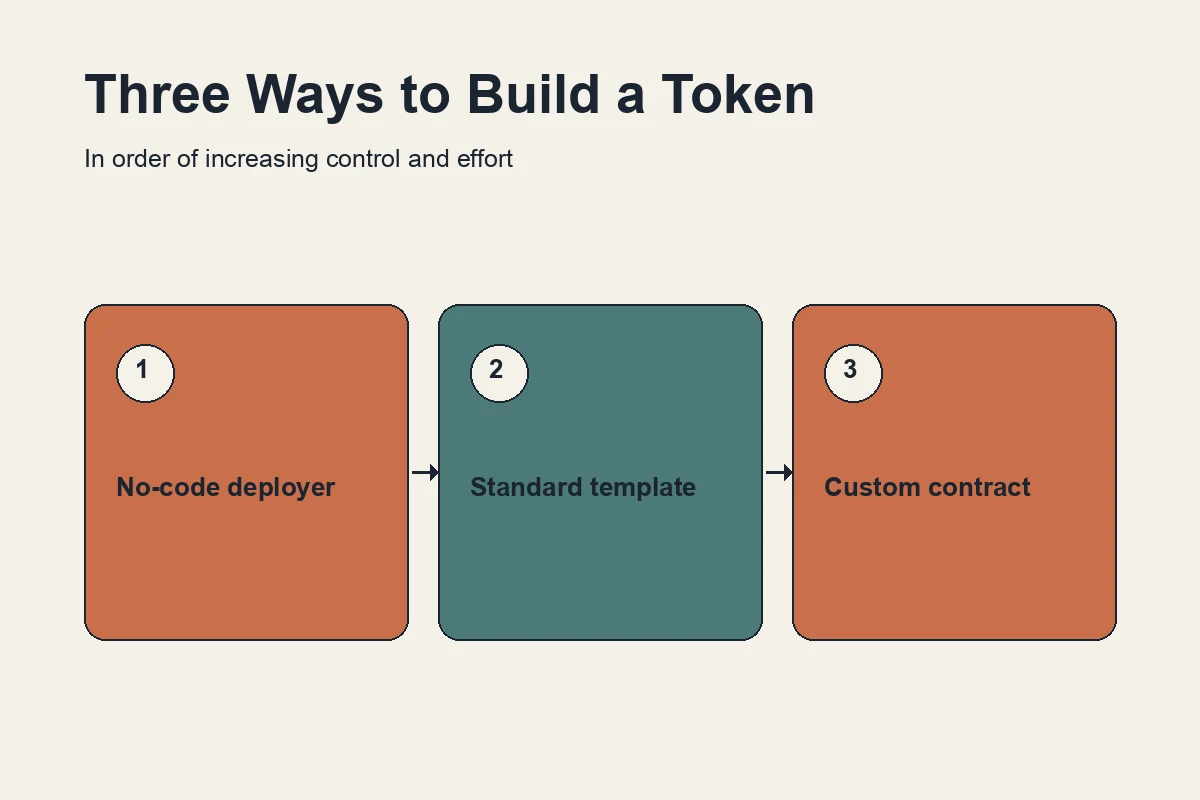
Assuming a token is the right fit, there are three broad routes, in increasing order of control and technical effort:
- No-code deployers — web tools that let you configure a basic token (name, supply, symbol) and deploy it without writing code. Fast, but limited to whatever the tool supports, and the underlying contract code is someone else’s.
- Standard token templates — using a well-audited, widely used standard such as ERC-20 on Ethereum, BEP-20 on BNB Chain, or SPL on Solana. This is the most common professional approach: proven code, broad wallet and exchange compatibility, and room to customize.
- Custom smart contracts — writing bespoke contract logic for non-standard behavior (vesting schedules, transaction fees, mint/burn rules). More flexible, but every custom line of code is also a new place for a bug or exploit to hide.
The official ERC-20 documentation is a good primary reference for what a standard token contract actually specifies, regardless of which chain you eventually choose.
Step 3: design the tokenomics before writing any code
Tokenomics — total supply, distribution, how (or whether) new tokens are issued over time, and what the token is actually used for — should be settled before development starts, not adjusted afterward. Changing supply mechanics after launch is difficult, often impossible without breaking trust with early holders, and sometimes technically impossible depending on how the contract was written.
Step 4: build, test, and get an independent security review
Whether using a template or custom code, the contract needs to be tested thoroughly on a public testnet before any real funds touch it, and — for anything beyond a personal experiment — reviewed by an independent security auditor. Smart contract code is immutable once deployed in most cases; a bug found after launch is far more expensive than one found before it.
Step 5: launch and maintain
Launching means deploying the contract to the mainnet, then handling the parts that aren’t code: getting listed on wallets and, eventually, exchanges; communicating clearly with holders; and maintaining whatever infrastructure the project depends on. A token doesn’t stop requiring attention once it’s deployed.
What this actually takes
Creating a basic token has become technically accessible — in some cases achievable in under an hour with a no-code tool. Building something that holds up long-term — with sound tokenomics, audited code, and an actual reason for people to hold it — is a different scale of effort entirely. Plenty of tokens launched with enthusiasm and little planning end up worth a fraction of their starting value; that outcome has far more to do with tokenomics and use case than with the deployment step itself. This guide describes the mechanics, not a recommendation to launch a token as an investment.
Common mistakes worth avoiding
A few patterns show up repeatedly in projects that struggle after launch:
- Treating tokenomics as an afterthought. Supply, distribution, and unlock schedules get decided in an afternoon, then the team spends months building on top of a foundation nobody stress-tested. Once holders are involved, changing these numbers erodes trust even when it’s technically possible.
- Copying contract code without understanding it. Forking a popular template is a reasonable starting point, but deploying code nobody on the team can explain line by line means nobody can catch a subtle bug — or a subtly malicious modification — before it costs someone money.
- Skipping the testnet stage under time pressure. A public testnet run is where obvious mistakes get caught for free. Rushing straight to mainnet to hit a launch date trades a cheap mistake now for an expensive one later.
- Budgeting zero time or money for a security review. An audit doesn’t guarantee safety, but skipping one entirely on anything holding real value is a common reason small, avoidable bugs turn into large, public losses.
- Building a token before confirming anyone needs it. The tokenomics and the audit only matter if there’s a real use case underneath them — see step 1. A well-executed token with no reason to exist is still a token with no reason to exist.
For the underlying technology this all depends on, see what is a blockchain? Next: a closer look at coin vs. token, and when building your own blockchain actually makes sense.