
Bitcoin was created in January 2009, when its first block — the genesis block — was mined. This guide covers that history at a level that sets up why it still matters for anyone creating a coin or token today.
Before Bitcoin: the problem it solved
Digital cash had been attempted before, but every earlier version ran into the same problem: without a central authority, how do you stop someone from spending the same digital token twice? Earlier systems either required a trusted central operator to check balances, or couldn’t fully solve the problem in a decentralized way. Bitcoin’s contribution was a way to solve “double-spending” without any central authority at all, using the blockchain and consensus mechanism described in what is a blockchain.
The attempts that came before it
Bitcoin didn’t appear out of nowhere — its whitepaper directly cites earlier work it built on. Cryptographer David Chaum’s DigiCash, developed in the late 1980s and 1990s, pioneered cryptographic digital cash but still relied on a central issuer, which meant it inherited the same trust problem it was trying to route around. Adam Back’s Hashcash, created in 1997 as an anti-spam mechanism, introduced the “proof-of-work” idea Bitcoin later adopted for mining — a way to make an action costly enough to deter abuse without requiring a central gatekeeper. Wei Dai’s b-money proposal, circulated in 1998, sketched out a system for anonymous, distributed electronic cash conceptually close to what Bitcoin would later implement, but was never built. Bitcoin’s whitepaper combined proof-of-work with a shared, replicated ledger to finally close the gap those earlier efforts couldn’t: decentralized agreement on who owns what, without a trusted party.
The whitepaper: October 2008
In October 2008, a paper titled “Bitcoin: A Peer-to-Peer Electronic Cash System” was published under the name Satoshi Nakamoto, laying out the design for a currency that didn’t need a bank or any central issuer. The original document is still publicly available at bitcoin.org and remains the primary technical source for how the system was originally designed.
The genesis block: January 2009
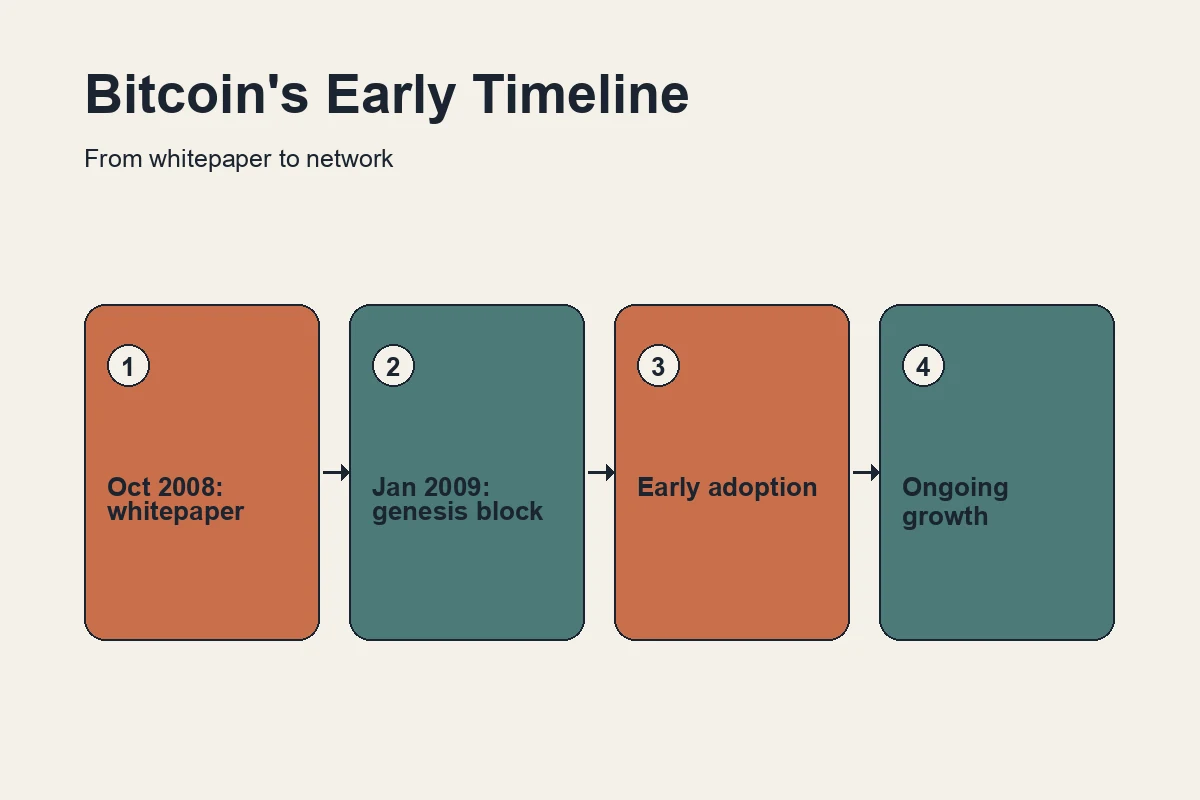
A few months after the whitepaper, the Bitcoin network went live with the mining of block 0 — the genesis block — in January 2009. Embedded in that block’s data is a newspaper headline referencing bank bailouts, widely read as a comment on the financial-system trust problem Bitcoin was designed to route around. The first Bitcoin transaction between two people followed shortly after, and the network has run continuously since.
In those earliest weeks, Nakamoto was effectively the only person running the network, which meant Bitcoin’s decentralization was more a design property than an immediate reality — it took other participants choosing to run their own nodes and start mining for the “no single party controls this” claim to become true in practice rather than just in theory. That gradual, voluntary adoption by independent operators is the same process every public blockchain still depends on today, and it’s still ongoing — new nodes join the network on an ordinary day in exactly the same voluntary way.
Early adoption: from curiosity to currency
For its first year or so, Bitcoin had no market price at all — there was no exchange to trade it against a currency, and it circulated mainly among early cryptography and peer-to-peer enthusiasts who mined it on ordinary home computers. The first widely cited real-world purchase came in May 2010, when a developer paid 10,000 BTC for two pizzas — an event still commemorated in the Bitcoin community each year, and often used as a reference point for how far the network’s adoption and price moved from those earliest days. Exchanges allowing Bitcoin to be traded for traditional currency followed over the next couple of years, which is what turned a working technical experiment into something with an observable market value.
Who is Satoshi Nakamoto?
Satoshi Nakamoto is a pseudonym; the real identity behind it has never been confirmed. Nakamoto was active in Bitcoin’s early development and communications until disappearing from public involvement around 2010–2011, and has not been definitively identified since — despite many claims and investigations over the years. This guide treats that identity as genuinely unresolved rather than asserting any specific candidate.
The anonymity wasn’t incidental to the project — it reinforced the thing Bitcoin was trying to prove. A currency that depends on trusting its founder isn’t meaningfully different from a currency that depends on trusting a bank; it just moves the trust problem rather than solving it. By stepping away and leaving no single person in charge, whoever was behind the pseudonym left the network’s rules to be enforced by its code and its participants rather than by continued involvement from its creator. Whether that was a deliberate design choice or simply how events unfolded, it’s part of why Bitcoin is widely described as having no owner today — a description that would be far harder to make credibly if its founder had stayed publicly involved and in control of it.
Why Bitcoin’s creation still matters
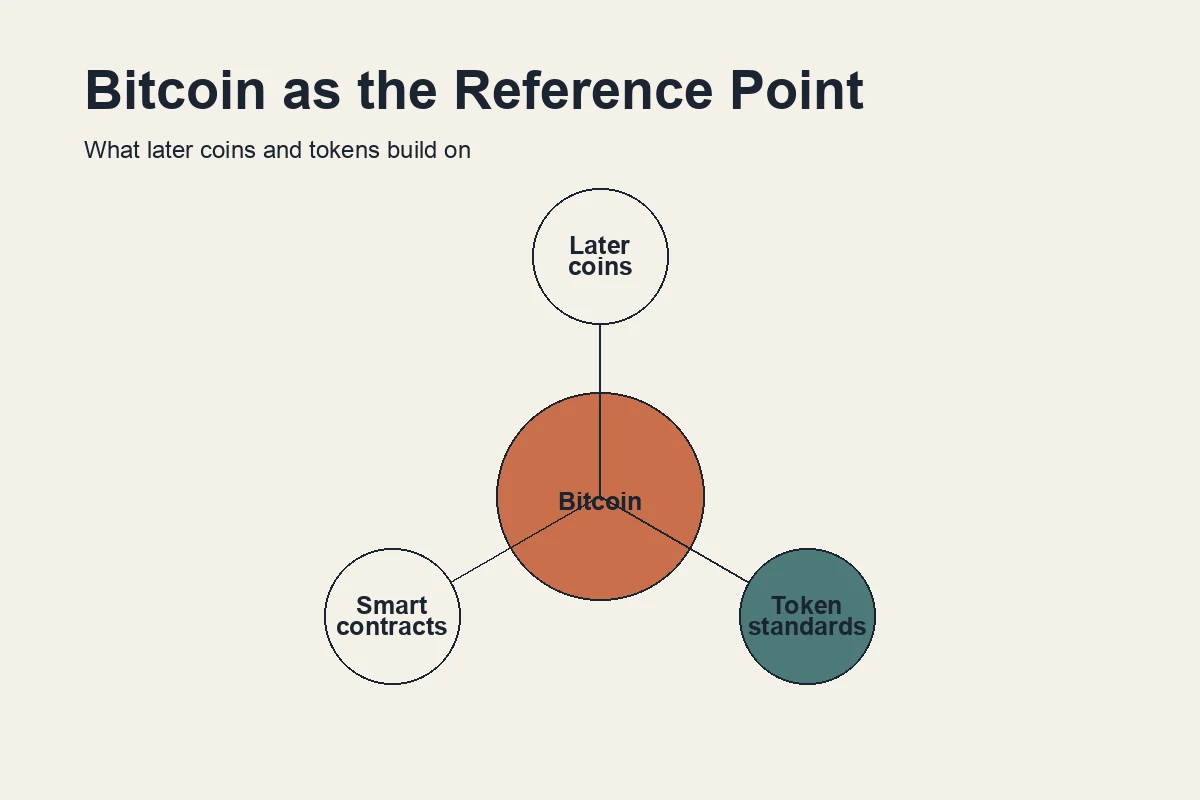
Every coin and token that exists today builds on ideas Bitcoin proved out first: a shared ledger with no central operator, cryptographic linking between blocks, and a way for independent participants to reach consensus. Later networks like Ethereum extended that foundation to support programmable smart contracts, which is what makes today’s token standards — see coin vs. token — possible at all. Understanding where the technology started is useful context for understanding what it can and can’t do now.
It also sets a useful baseline for expectations. Bitcoin took years of unglamorous, low-attention development before it had any market value at all, and its core design hasn’t fundamentally changed since 2009 — the same block-and-hash mechanism is still what secures it today. Projects that expect a new coin or token to reach that kind of durability on a much shorter timeline, with far less scrutiny of the underlying design, are working against the actual history of how the first one got there.
Back to the practical question this history sets up: how to make a crypto coin.